
Last updated: October 2026
Short answer: Most HOA communities need four layers of security: gate access control at vehicle and pedestrian entrances, video surveillance covering entrances and shared amenities, controlled entry to amenities like pools and clubhouses, and an intercom or visitor system so guests and deliveries get in without propping gates open. The goal is to keep common areas safe and give the board a clear record of who comes and goes.
HOA security is different from a single business. You're protecting shared spaces used by hundreds of people, managed by a volunteer board and a property manager, and paid for out of the community budget.
What Should an HOA Secure First?
- Entrances and exits. Gates, guard houses and pedestrian gates are where every visit starts. Cameras here should capture vehicles and license plates clearly.
- Amenities. Pools, gyms, clubhouses and playgrounds see the most liability risk and the most after-hours misuse.
- Mailrooms and package areas. Package theft is one of the most common complaints in shared communities.
- Maintenance and storage areas. Equipment and supplies paid for by the HOA need protecting too.
How Does Gate Access Control Work for an HOA?
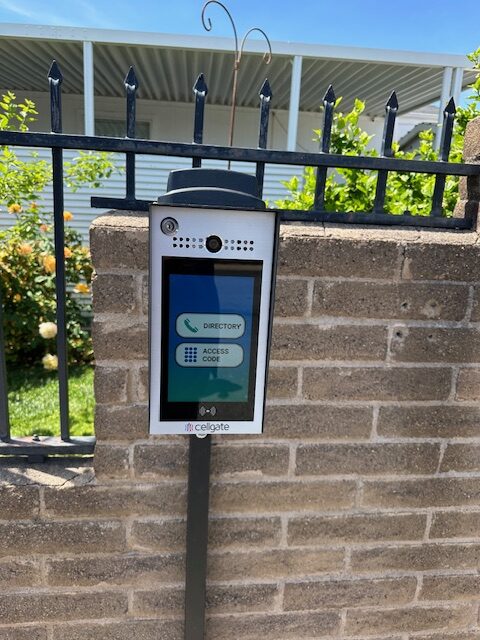
Modern gate systems let residents enter with a key fob, credential, keypad code or phone app. Each credential is tied to a resident, so the property manager can add or remove access in minutes when someone moves out, without re-keying anything or changing a code everyone shares. A cloud-managed intercom at the gate, like the CellGate system shown above, lets visitors call a resident who can open the gate from their phone.
Learn more about our access control systems and how keyless entry replaces shared codes.
Where Should Cameras Go in an HOA Community?
Good coverage starts at the edges. Cameras should cover every vehicle and pedestrian entrance, the amenity areas, the mailroom and any spot with a history of problems. Camera placement should respect residents' privacy, so cameras point at common areas, not into homes or private yards. Sharp footage at the gate is the single most useful thing for an HOA, because it answers "who came in, and when?" See our video surveillance services.
Can Amenity Access Be Controlled Separately?
Yes. The same credential that opens the main gate can open the pool or gym, but only during set hours. If a resident's dues fall behind or rules are broken, the board can suspend amenity access without touching gate access. Access logs also show who was inside if something gets damaged.
What Should HOA Boards Ask Before Choosing a System?
- Can the property manager add and remove residents remotely?
- Does the camera system integrate with the gate, so footage lines up with each entry?
- Who provides support when the gate goes down at 9 p.m. on a Saturday?
- Can the system grow as the community adds amenities or phases?
Our guide on how to choose a security system integrator covers more questions to ask.
Frequently Asked Questions
Is a gate enough to secure an HOA?
No. A gate controls entry, but cameras, amenity access control and a visitor system are what make it effective and give the board a record when something happens.
Can residents open the gate with their phone?
Yes. Many modern gate systems support phone-based entry along with fobs and keypads.
Can you upgrade our existing gate instead of replacing it?
Often, yes. Many gates can be retrofitted with new access control and intercom hardware. We'll assess what you have first.
Do you work with property management companies?
Yes. We work with HOA boards and property managers across Lodi, Stockton, Elk Grove, Sacramento and the Central Valley. See our areas served.
Schedule Your HOA Site Consultation
Golden State Security Integrations is a licensed commercial security integrator serving Lodi, Stockton, Sacramento and the Central Valley, with technicians certified on Avigilon, Lenel, HID, Genetec and Axis systems.
Request a free security assessment or call 209-227-3428 to talk to a security specialist.